
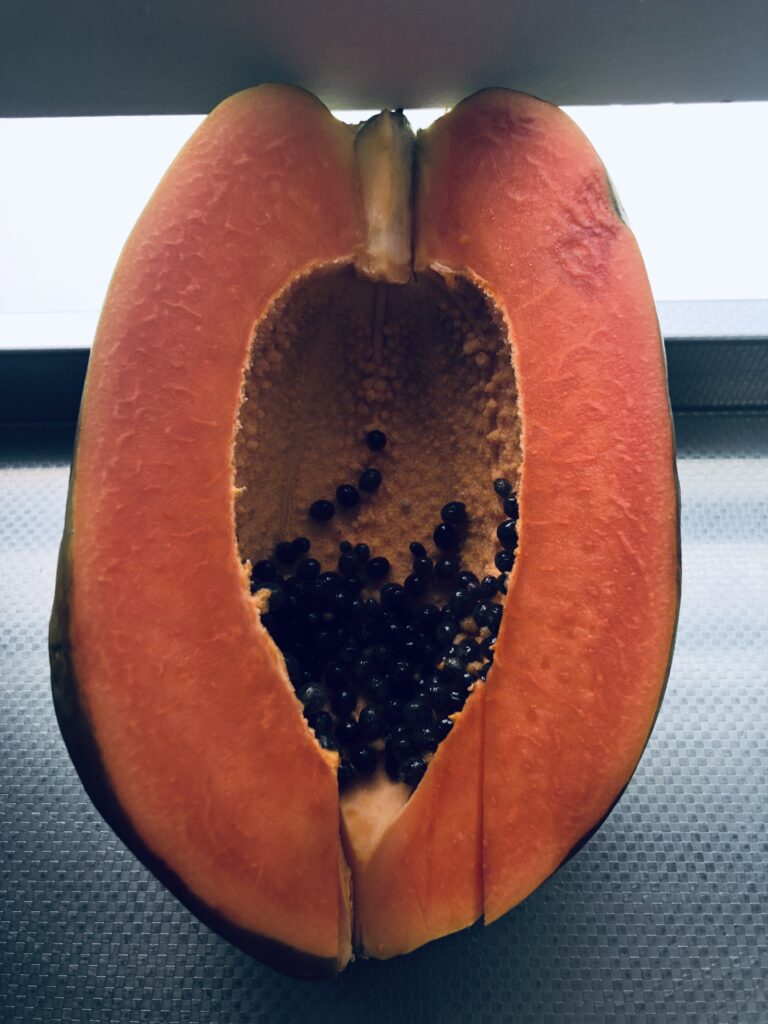
Sweet papayas are also great! From my own tree in Venezuela
Dear reader,
When writing about sweet potatoes, we should focus on more than just the (overhyped) concept of super foods. It’s neither the comparison between sweet potatoes and regular potatoes either. It’s also a story about pesticides conflicting with the great health contribution of peels.
Finding a balance between nutritious peels and harmful pesticides is not easy. Bio is best, but not always available or sometimes too expensive. It is difficult to make the right decision, because we do not know exactly how harmful pesticides are. Neither do not know how much the peels positively impact health.
Sweet potatoes a super food?
Sweet potatoes are a delicious vegetable and are often labeled as a super food. As written before, I am skeptical about the label of super food. Super food lacks a scientific definition and one can use it at will.
Super food sounds like superman, the guy who can solve everything. Well, super food can not and are not a direct way to health heaven. They offer a lot of excellent nutrients per unit which in itself is very important. Much food offers little good nutrients, like soppy white bread, white rice or the ever present ultra-processed food. All full of empty calories.
Sweet or regular potatoes?
It is often suggested that sweet potatoes are much better than regular potatoes. They are not much better, except for perhaps one cancer-fighting reason. This reason is not fully proven yet scientifically (more about this point below). There are differences between sweet and regular potatoes of course, but the health balance of each is not much different.
Sweet potatoes offer significantly more Vitamin A and fiber. Regular potatoes generally provide more potassium, iron, and B vitamins like B6. Both are nutritious root vegetables with similar carbs. Sweet potatoes lean sweeter and higher in sugar. Regular potatoes are starchier. Preparation heavily influences their glycemic impact.
Calories? Sweet potatoes and regular (white/Russet) potatoes have very similar calorie counts. The differences in calories are usually minimal, around 85–110 calories per 100 g raw. Frying drastically increases calories in both, while baking or boiling keeps them lower in calories. I always choose the oven without adding oil.
Resistant starches from potatoes have about 2.5 calories per gram, while regular starches contain about 4 calories per gram. As such, it may help to swap other starches for resistant starches if you’re looking to lose or maintain weight.
Both regular potatoes and sweet potatoes contain significant amounts of digestible (regular) starch, but they also provide resistant starch. This is a type of fiber that resists digestion and promotes gut health. Cooling cooked potatoes (including sweet potatoes) significantly increases their resistant starch content. Advice: always precook your (sweet) potato and let it cool before using it in the preparation of your meal.
The reasons I prefer sweet potatoes
First, the taste! The only drawback is figuring out how to make excellent French fries from sweet potatoes without frying them in oil. I do this in the oven, but with precooked regular potatoes it turns out well. Sweet potatoes, on the other hand, remain a challenge. One day it will work out fine; I am sure of it.
Second, there are indications that sweet potatoes have anti-cancer properties. While the majority of this research has been conducted in laboratory cell cultures and animal models, the findings are promising. Human clinical trials are needed to confirm these effects fully.
More about the peels
Why peels? Peels often contain more nutrients than the pulp. While exact percentages vary by produce, studies indicate that skins can contain 50% or more of certain nutrients. In some cases, they have over 300% more antioxidants than the pulp. So throwing away peels, as many of us do, means discarding a lot of essential nutrients.
Some examples of nutrients in peels
An apple with skin contains up to 332% more vitamin K than a peeled apple. The skin also has 142% more vitamin A. It contains 115% more vitamin C and 20% more calcium.
Removing the tomato skin can result in a loss of up to 80% of its lycopene.
The peel of a fresh carrot makes up only 11% of its weight. However, it contains 54% of its phenolic acids (antioxidants).
A citrus peel can contain twice as much vitamin C as the fruit’s flesh. • Boiled potato skin can contain up to 175% more vitamin C than a peeled potato. It holds 115% more potassium. Additionally, it contains 110% more magnesium and phosphorus.
Peels and pesticides
The problem, however, is that peels often contain pesticides. These can remain on many fruits and even penetrate the first few millimeters of the pulp. So peels contain high levels of nutrients, but they also carry a high concentration of pesticides.
Debates about pesticides are numerous and often contradict one another. Companies and farmers claim that there are safe levels of pesticides, or that some pesticides are safe for humans. I would like to believe this, but I do not.
To minimize exposure, it is recommended to wash all produce. However, washing is only half as efficient as peeling. As mentioned before, organic is the best option, but cost can be an important factor. Take kiwis. I love kiwis. In general, organic kiwis are twice as expensive as the regular ones. So, in the case of kiwis, I prefer to peel.
Produce with thin or no skin, like apples, strawberries, and peaches, tends to hold more pesticides in the peel. This is not surprising. Thick-skinned produce (avocados, bananas) are much less affected.
Blueberries and strawberries are among the worst when it comes to pesticide residues. Unlike kiwis, which at least can be peeled, this option does not exist with these berries. Conclusion: only eat blueberries and strawberries when you can buy them organic.
What Is Resistant Starch? And Why Is It So Important?
Resistant starch is a type of complex carbohydrate that resists digestion in the small intestine. It functions as a prebiotic fiber. It escapes digestion in the small intestine. The starch is fermented in the large intestine by gut bacteria. This fermentation produces short-chain fatty acids (SCFAs), such as butyrate, acetate, and propionate. These fatty acids can be absorbed and used by the body. They may support gut and metabolic health. Note that resistant starch provides energy mainly through SCFAs rather than glucose.
Carbohydrates can be simple or complex. Simple carbohydrates have a simple chemical structure and are digested quickly into glucose. They are common in foods like candy, white bread, and white rice.
Anti-cancer
The potential anti-cancer effects attributed to sweet potatoes arise from several bioactive compounds found in the plant. Anthocyanins are abundant in purple-fleshed varieties. They are powerful antioxidants. These antioxidants have shown anti-cancer effects in test-tube and animal studies.
These effects include inhibition of growth in cancer cells and promotion of apoptosis (programmed cell death). Beta-carotene gives orange-fleshed sweet potatoes their color. In the body, it is converted to vitamin A. Some epidemiological studies have associated it with a lower risk of certain cancers. Dietary fiber supports gut health and may reduce colorectal cancer risk. Sweet potatoes also contain sporamins (a storage protein) with antiproliferative effects in laboratory and animal studies. Polyphenols and flavonoids are found in leaves, stems, and the edible roots. They help modulate inflammatory pathways. They also inhibit cell-cycle progression and protect DNA. I wrote a blog on the many potentials of the 8.000 polyphenols. https://shakethehealthtree.com/index.php/2025/12/02/5-polyphenols-8000-interesting-plant-derived-compounds-health-project99/
In summary, my way forward:
- Choose sweet potatoes, preferably with the peel and, when possible, organic.
- Use cooking methods that preserve resistant starch (e.g., boil, then cool before reheating) to maximize resistant starch content.
- Include them a few times per week, with oven-baked, oil-free French fries as a tasty option.
Enjoy life, enjoy your dinners with sweet potatoes and take care!
Robert, your health friend

A day in the cactus woods of Curacao