
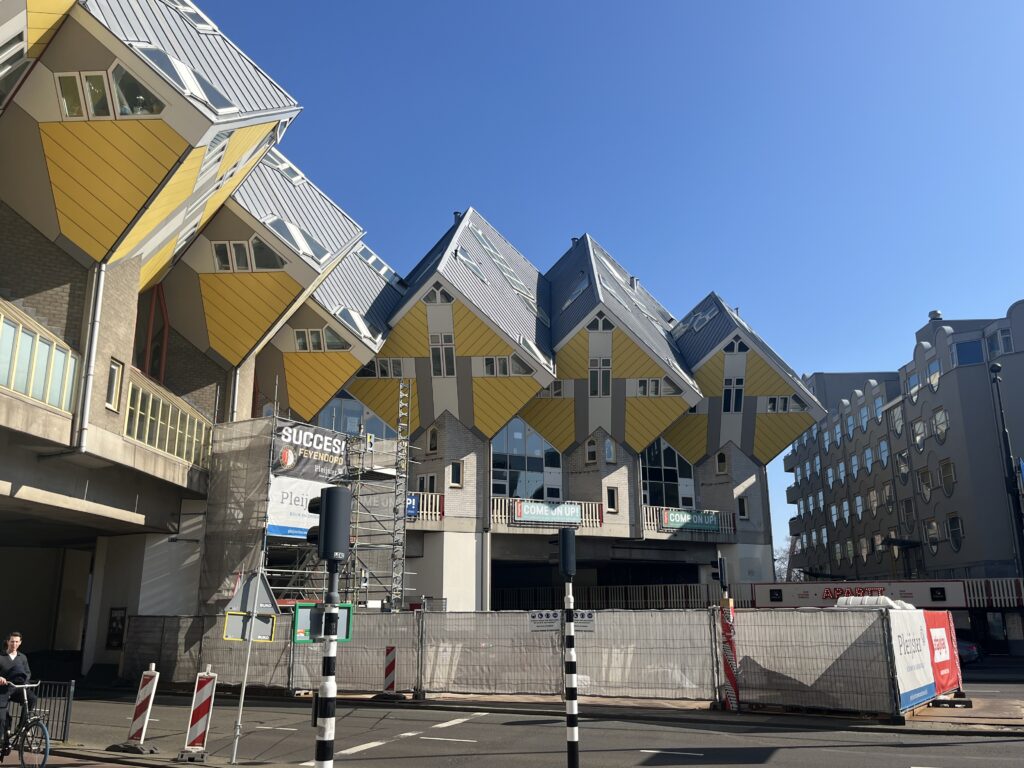
Houses in Rotterdam, the Netherlands
Dear reader,
The fancy name for red-light therapy is photobiomodulation. It is based on NASA research of about 20 years ago.
(1) “Red-light therapy” and (2) “Infrared light in saunas” are very different. I often confuse these two, so writing down the differences helped (me at least). I am convinced of the added benefits of both, so I plan to use each one of them.
Very short: red light is for skin and collagen, infrared for muscles. And more of course, but this is the essence.
At home we have an infra-red-light cabin, which I use to recuperate after sports and as a preventive measure to avoid catching a cold. https://shakethehealthtree.com/index.php/2025/02/26/1-my-health-essentials-infrared-sauna-health-project-99/
In this blog I give some considerations that led me to my red-light choice (for a soft LED mask + something for the neck and upper part of the chest).
1.Main tip
There are many fake devices around, so buy quality and use the device consistently. Improvements on skin and collagen are substantial (according to many independent studies) but will gradually disappear when you stop. Red light therapy really works but consider it as a lifelong commitment. Three times per week, 10 minutes.
2.Are the acclaimed results of red-light therapy fact or make-believe?
The good news is that red-light therapy is indeed scientifically proven to improve skin health, reduce inflammation, promote wound healing, reduce pain, and stimulate collagen production. More research is needed for another claim, namely that red light improves overall health (cellular energy enhancement); scientific indications so far are rather positive. If correct red-light will contribute to longevity!
3.Is the sun alone not enough?
The idea that you don’t need red light therapy because the sun provides enough light has some truth, as sunlight includes a broad spectrum of light, including visible light (red light) and near-infrared (NIR).
The problem is that the amount and quality of sunlight you receive varies greatly by time of day, weather, location, and season. As I made clear in this blog, in order to profit from a health step, whether it is exercise, a supplement or light, one needs consistency. The advantage of artificial red-light therapy and NIR devices is that they can deliver light at intensities and durations optimized for therapeutic effects, which can be hard to achieve safely with sun exposure alone.
In addition, as we all know, direct sunlight exposure comes with UV radiation, which increases the risk of skin damage and skin cancer if exposure is excessive. Excessive exposure already happens after less than half an hour. It can shorter as damage depends on skin type, UV index, and other factors.
4.What is infrared light?
Red-light therapy uses very specific visible red wavelengths (often combined with other red light that is very close in wavelength to the visible red wavelengths, the so-called Near Infra-Red = NIR) to promote healing and regeneration without significant heat. Red light (as part of red-light therapy) is visible; infrared light on the other hand is not.
The main, but lesser known, output of red-light therapy probably is “cellular energy enhancement” just under the surface, while heat production is the main benefit of infrared light.
Most people use red-light therapy to achieve skin improvement and collagen production. The fact that there are strong scientific indications that it probably also leads to better working of your cells just below the surface is an unexpected bonus. For those who care about longevity this is an important development.
Red light therapy uses visible red light, typically in the wavelength range of about 620 nm to 700 nm, sometimes combined with near-infrared light (700 nm to 1400 nm), to stimulate cellular repair and other health benefits.
Red light therapy is provided by handheld devices, panels, masks, and even sleeping bags and other whole-body capsules.
5.The different wavelengths
For those who love figures, see the following overview. I use nanometers (100,000 nanometers = 1 millimeter). Sometimes you read about microns. Just remember that 1 micron = 1000 nanometers.
Red light therapy (visible to the human eyes): 620 nanometers to 700 nm
Infrared light (invisible to the human eyes):
a) Near infrared (NIR): 700 nm to 1400 nm
b) Mid infrared (MIR): 1400 nm to 3000 nm
c) Far infrared (FIR): 3000 nm to 100,000 nm (= 1 mm)
The boundaries between these infrared ranges are approximate and can vary slightly based on different scientific definitions.
MIR and FIR are used in saunas as their heat is absorbed mostly by the surface of the skin. It leads to general relaxation of the muscles and detox sweating. NIR penetrates the deepest, then MIR, while FIR mostly heats the surface and just below it.
6.Some more relevant figures to look for.
Irradiance / Power Density (mW/cm²): This refers to how much light energy hits a given area per second. Higher irradiance means shorter treatment times. Typical effective irradiance values start around 20 mW/cm² and can go up to around 100-200 mW/cm². The new one we bought has 35 mW/cm². This is measured directly on the face and can therefore be less than for a panel, where the red light has to bridge a certain distance. In general, devices with low irradiance may require longer exposure.
Energy Dose / Fluence (J/cm²) = Total energy delivered per area during a session. Calculated as irradiance (mW/cm²) × treatment time (seconds) = energy dose (mJ/cm²), converted to J/cm² by dividing by 1000.
7.NIR light has dual use
Near-Infrared (NIR) light has wavelengths that fall between visible red light and mid-infrared wavelengths, typically around 700 to 1400 nm. It is a bit of an in-between wavelength that can be used as part of the red-light therapy and in infrared saunas.
The combination with red light therapy enhances therapeutic effects because it penetrates deeper into tissues. NIR is also sometimes included in infrared saunas, especially those that use near-infrared lamps, either alone or in combination with mid- and far-infrared wavelengths. This is because NIR targets different therapeutic outcomes, such as promoting cellular repair and improving circulation.
8.What to buy?
Most research has been done with masks, and I have decided, for the time being, to only go for a soft mask (+ a part for the neck and upper part of my chest). Perhaps in the future I will go for something that reaches the whole body, but I need to see more research about this, and prices have to go down.
Most devices use LEDs, but some have lasers, which are more expensive and in general only used in clinical or professional settings.
9.What about the blue light option?
The blue light option in a red-light therapy device is not essential but can be beneficial for specific purposes. Red/near-infrared light primarily targets tissue healing, inflammation reduction, and collagen production. Blue light (around 415 nm) is used mainly for its antibacterial properties, making it helpful in treating acne and skin infections.
If your primary goal is anti-aging, pain relief, or muscle recovery, blue light is less important. If you want acne treatment or antibacterial effects, a device with blue light can be useful.
10.My experience so far
My wife and I were convinced by all the studies and bought both a face mask and a bridge that covers your face and neck. We made a few mistakes though.
- The face mask was rigid and too small for me. The bridge was okay, but the prescribed time of procedure (30 minutes) was too long.
- We did not check the brands, just bought a few from Amazon. I know now that this has been a bad idea, as quality counts.
- We did not use it consistently. My wife was, for the period that she used the face mask regularly, quite positive about the results, by the way.
So we changed mask. Which is the new one?
I did thorough research, which was not successful. Thousands of influencers around, but I did not find them helpful. I could not find a reputable source that made a comparative study of all devices that are on the market.
However, at a certain moment one must take a decision, so I went for a recent article in a reputable newspaper: the New York Times. The person who did the comparative research had impressive qualifications and had consulted several dermatologists. Based on her recommendations I bought Omnilux Men. This is marketed primarily toward men, but the device itself can indeed be used by women. It is a soft, flexible mask + an additional one for the neck and upper level of the chest. Expensive (2x 400 euros).
https://www.nytimes.com/wirecutter/reviews/best-red-light-therapy-skin-care-device/
11.The decision to choose the category was easier.
No handheld devices for us. There are many of them, but it is cumbersome to keep them on a certain place at the right distance, then move to the next place and that three times a week.
The same with panels. You must stay within a certain distance. How far depends on the power output of the panel, the “irradiance.” Sitting still, at the right distance, is not for me.
I love the concept of full body devices like sleeping bags. For the time being I am not convinced that they offer enough quality and indeed have an impact on the whole body (the skin of your neck is very thin while the surface of your legs is different).
So, we decided to go for something that is attached to your body, in this case to that part that is most visible: your face and neck. It is also this combination (mask device – face) that has undergone most scientific tests.
12.Buying a red-light device take into account the following
- Choose a quality brand, FDA or similarly approved. CE marking and other safety standards are additional positives. There are many fakes around. I am sure, as some claim, that many of these devices come from the same factory and that some of the cheap ones are as good as the expensive ones with a brand name on it, but I do not want to take the risk.
- Wavelengths for visible red light (at least 620-700nm) and near-infrared light (at least 820-940 nm). For masks that mix blue light with red light, the sweet spot for blue is around 415 nm. If you wish to have deeper penetration of the red light, also include around 1064 nm.
- Check if the LEDs are certified or have quality ratings (e.g., LED lifespan, consistency).
- Lights should have a 50,000 hours lifespan.
- Buy devices that have a trial period and offer excellent warranty.
- Choose a brand that has been on the market for a longer period.
- The irradiance (power over an area, measured in milliwatts per square centimeter) should be for soft masks at least 30 mW/cm², hard masks and wands at least 50 mW/cm².
Dear reader, some health equipments are essential. In my conviction an infrared device is one of them.
Take care and live a healthy and long life,
Robert, your health friend

Atlas Mountains in Morocco
Some words on CE marking
- This is a certification mark that indicates a product complies with the relevant European Union (EU) health, safety, and environmental protection standards. It allows the product to be legally sold and distributed within the European Economic Area (EEA), which includes all EU countries plus Iceland, Liechtenstein, and Norway.
- CE stands for “Conformité Européenne,” which means “European Conformity.” It applies to many products, including electronics, medical devices, machinery, toys, personal protective equipment, and more. So make sure that there is a CE mark when choosing a red light therapy device.